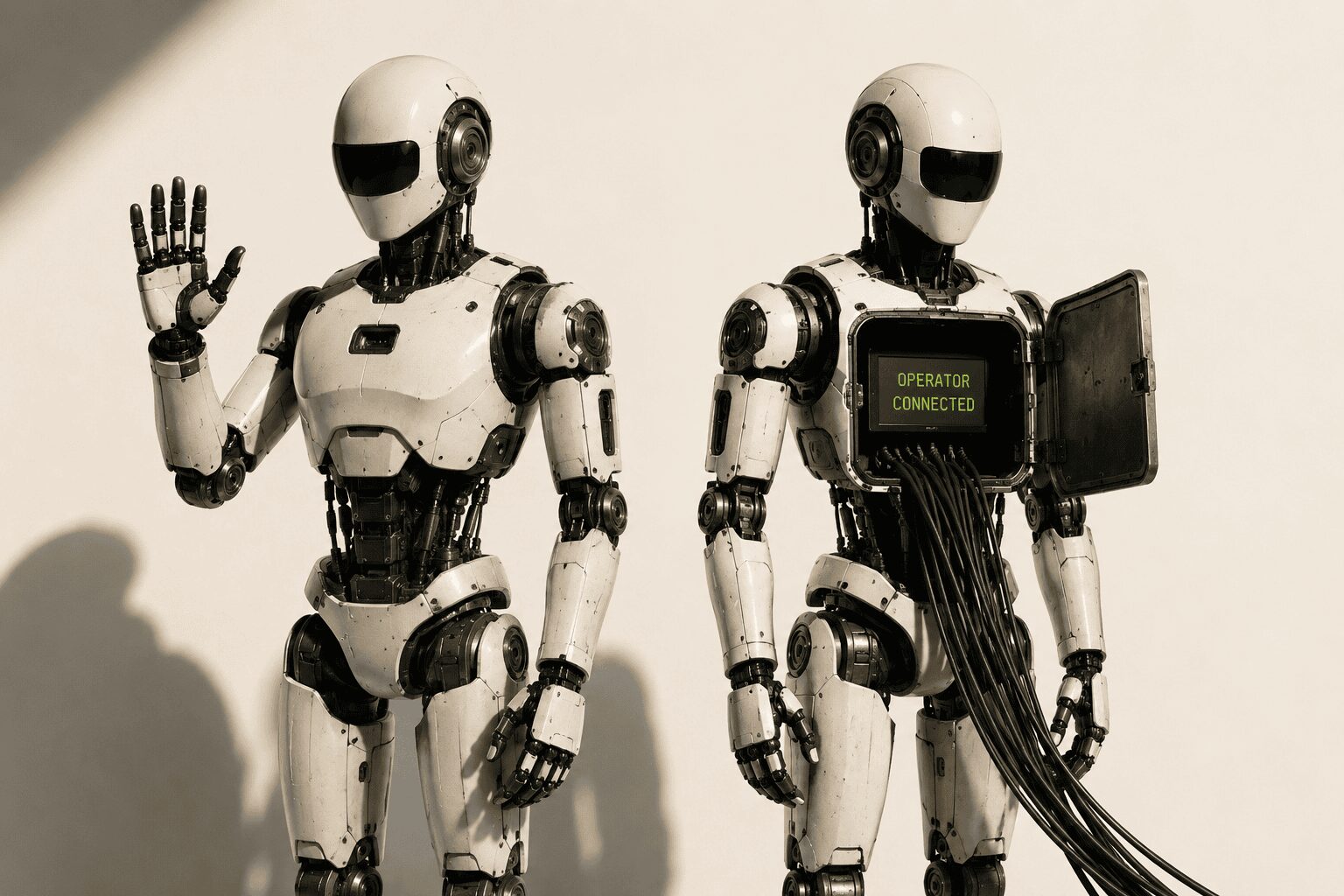
The past fortnight has been good for humanoid robots. Three Figure 03 units ran an autonomous package-sorting shift on a public livestream. A London startup signed a 2,000-unit deal with one of Germany’s most conservative engineering companies. Japan Airlines began a three-year humanoid trial at Haneda Airport. And right here in Australia, Andromeda completed the largest deployment of humanoid companion robots in aged care anywhere on the planet. The humanoid industry has actually arrived. The interesting question now is what it needs to build next.
On the 14th of May, Figure AI ran a livestream on YouTube. Three of their Figure 03 humanoids – Gary, Bob, and Frank – worked an eight-hour package-sorting shift in real time. The company also said a separate Figure 03 unit named Jim, running the same Helix-02 software at a different logistics site, had autonomously sorted 101,391 packages over 81 hours. CEO Brett Adcock went on Bloomberg the next day to talk about it.
The livestream drew the predictable internet response: some viewers spotted what they thought were tells of remote operation, the conversation went around, and Brett denied any teleoperation categorically. None of us watching from outside has a way to settle that argument with certainty. But step back from the row and the larger picture is what matters. A humanoid robot company is now confident enough to invite a million viewers to watch its product work in public for eight hours. The sector did not have that kind of confidence in 2024. That is genuinely a big deal, and it is worth noticing before we get to the harder question of what comes next.
This was the fortnight humanoids stopped being a future story
Three other moves in the same window mattered at least as much as the livestream.
On the 13th of May, a London-based startup called Humanoid, founded just two years ago by Artem Sokolov, signed a deal with Schaeffler to deploy 1,000 to 2,000 wheeled humanoid robots across Schaeffler’s global facilities by 2032. Schaeffler is one of the most conservative engineering houses in Germany – US$18 billion in revenue, 83,000 employees, an institution. They do not sign multi-year Robot-as-a-Service contracts with two-year-old startups on a whim. The deal also includes a five-year actuator supply agreement running in the other direction, where Schaeffler becomes Humanoid’s preferred supplier of joint actuators – a seven-digit number of them by 2031. So Schaeffler is simultaneously buying robots AND getting paid to manufacture the parts that go inside them. That is the kind of two-way commitment you see in industries that have moved well past pilot mode.
Japan Airlines started a three-year trial of Unitree G1 humanoid robots at Haneda Airport on the 1st of May, running through 2028. The robots will do baggage loading, container transport and aircraft cabin cleaning, under human supervisor oversight, in one of the most safety-paranoid regulatory environments on the planet. The Unitree G1 retails for around US$15,400 a unit. That is below the cost of a forklift. JAL is doing this for sensible reasons – their ground crew is 20% short and Japan is running out of warm bodies. At that price point and that level of supervision, the economics actually pencil out. This is what mature deployment looks like.
And here in Australia, Melbourne-based Andromeda Robotics finished the world’s largest deployment of humanoid companion robots in aged care on the 17th of April. Twenty-two Abi units now live permanently across all of mecwacare’s residential aged care homes in Victoria, supporting more than 1,500 residents. Abi speaks around 90 languages, is built for dementia-friendly engagement, and is designed at eye level with seated residents in mind. Founder Grace Brown (originally from Brisbane) closed a A$23 million Series A in September last year led by US firm Forerunner Ventures, valuing the company at A$100 million, and is using the capital to expand into the United States while building Australia’s first humanoid robot production line at home. That is a genuine Australian technology champion in a category we have functionally never competed in. Grace and her team deserve a beer.
One thing is still missing, and this is the right moment to build it
When you put those four stories next to each other, an obvious question emerges. How do any of us – buyers, regulators, journalists, the broader public – know whether the capability claims attached to each of these deployments are accurate?
For Schaeffler, the answer is that their procurement team did the diligence and we have good reason to trust their judgement. For JAL, the answer is that they are running a supervised three-year trial with human oversight and will publish results as they go. For Andromeda, the answer is that mecwacare staff and residents will tell us over time whether Abi is doing what the company says it is doing. For Figure, the answer is that we are all watching the livestream and forming our own opinions.
None of those answers is wrong. But the sector is now big enough, fast-moving enough, and consequential enough that “trust the company” and “wait and see” probably are not the whole answer. Every other safety-relevant technology that touches the public has an independent verification regime to lean on. Pharmaceuticals have the TGA in Australia and the FDA in the US. Cars have ANCAP and NHTSA. Aviation has CASA and the FAA. Even the kettle on your counter has a tick-marked label on the back from an independent testing lab. Humanoid robots, for the moment, have none of that.
This is not a scandal. It is a stage of life. Every successful technology category in history has had to build its verification infrastructure at roughly the same time as it built its first generation of real products. Aviation built it. Pharmaceuticals built it. Cars built it. The humanoid industry is now ready to build its own version, and the good news is that the companies most likely to benefit are exactly the most credible operators in the field.
What a sensible verification regime would look like
It is not complicated. Four things matter.
Defined capability benchmarks. When a company says a robot operates “autonomously” for “eight hours” on a “task,” it helps everybody if those words have agreed-upon meanings. Standard definitions are how every other engineering discipline shifted from marketing copy to verifiable specification.
Independent third-party testing. The labs need to sit outside the manufacturer. The protocols need to be standard. The protocols need to be public. The template is well-established in every other industry that has been through this transition.
Continuous deployment monitoring. Not one-time certification. A humanoid robot’s behaviour changes every time its underlying software updates, which in some cases is weekly. The verification has to keep pace, the way ongoing software audit does in aviation and medical devices.
Public incident reporting. Aviation runs on this principle. It is the single biggest reason flying is the safest mode of transport on the planet. When something goes wrong with a humanoid in a workplace – and at scale, it eventually will – the rest of the industry needs the ability to learn from it.
ISO is already on the case. ISO 25785-1 is the first international standard explicitly aimed at “dynamically stable” robots, which is the formal phrase for robots that need active control to stay upright. The working group includes engineers from Agility Robotics, Boston Dynamics and the A3 Association – the kind of operators you want writing the rules. It is still a working draft, with publication expected in 2026 or 2027. That is good progress, and the fact that the best companies in the sector are doing the drafting is a strong signal. Useful work is also happening at ASTM, IEEE, and inside national regulators in the US, the UK and Japan.
Australia’s opportunity
Here is the positive case for Australia. We have a genuine humanoid company in Andromeda. We have world-class robotics research groups at Monash, UNSW, QUT, ANU and Adelaide. We have a National Robotics Strategy that estimates a potential A$201 billion economic uplift by 2040. And we have a Productivity Commission that has been thinking hard about how AI affects the labour market – even if I reckon their recent estimate that only 4% of Australian jobs are at high risk may prove conservative once you factor in physical-labour substitution at the cheap end of the humanoid market.
What we do not yet have is a coherent Australian position on humanoid verification. Safe Work Australia has not weighed in. The Aged Care Quality and Safety Commission has not produced specific guidance. There is no clear regulatory home for autonomous embodied agents. Right now that looks like a gap. Twelve months from now it could look like an opportunity.
Australia is small and quick on regulatory matters in a way that the US and the EU genuinely are not. There is a real chance to build a sensible verification framework here while the sector is still young – before the cheap Chinese humanoid hardware arrives at scale in 2027 and 2028, which it will. That kind of leadership is exactly what an Australian humanoid champion like Andromeda deserves to be backed by. It would also make Australia an attractive market for the credible operators in the sector while making it a less hospitable one for anyone trying to skip the homework.
Anyway
The humanoid moment has arrived. The Figure 03 livestream, the Schaeffler deal, the JAL trial and the mecwacare rollout are all evidence that the sector has crossed from “interesting” to “real” in 2026. I have been hosting podcasts about technology since 2004 and I know the difference between a hype cycle and a hinge moment. This one is a hinge moment, and most of the companies doing the heavy lifting deserve to be congratulated for getting us here.
What the sector needs next is the same kind of independent, standardised, public verification infrastructure that every other consequential technology category has eventually had to build. The companies that will benefit most are the credible ones. The industry, the regulators, and the public will all be better served if the sorting happens transparently than if it happens via lawsuits and incidents.
In the meantime, my advice to anyone evaluating a humanoid robot today is the same advice I give the QAV crowd about anything they are thinking about putting their money behind. Be enthusiastic. Be informed. Trust but verify. Don’t listen to stories – look at the numbers. The facts matter. Ask the obvious questions any serious claim deserves. And if a particular claim cannot yet be independently checked, that is not a reason to walk away – it is a reason to ask how soon it will be possible to check it, and to back the companies and regulators who are doing the work to get us there.
Cheers.
Cameron Reilly co-hosts the Futuristic podcast and is a principal consultant at The Futuristic Group. He is based in Brisbane.