
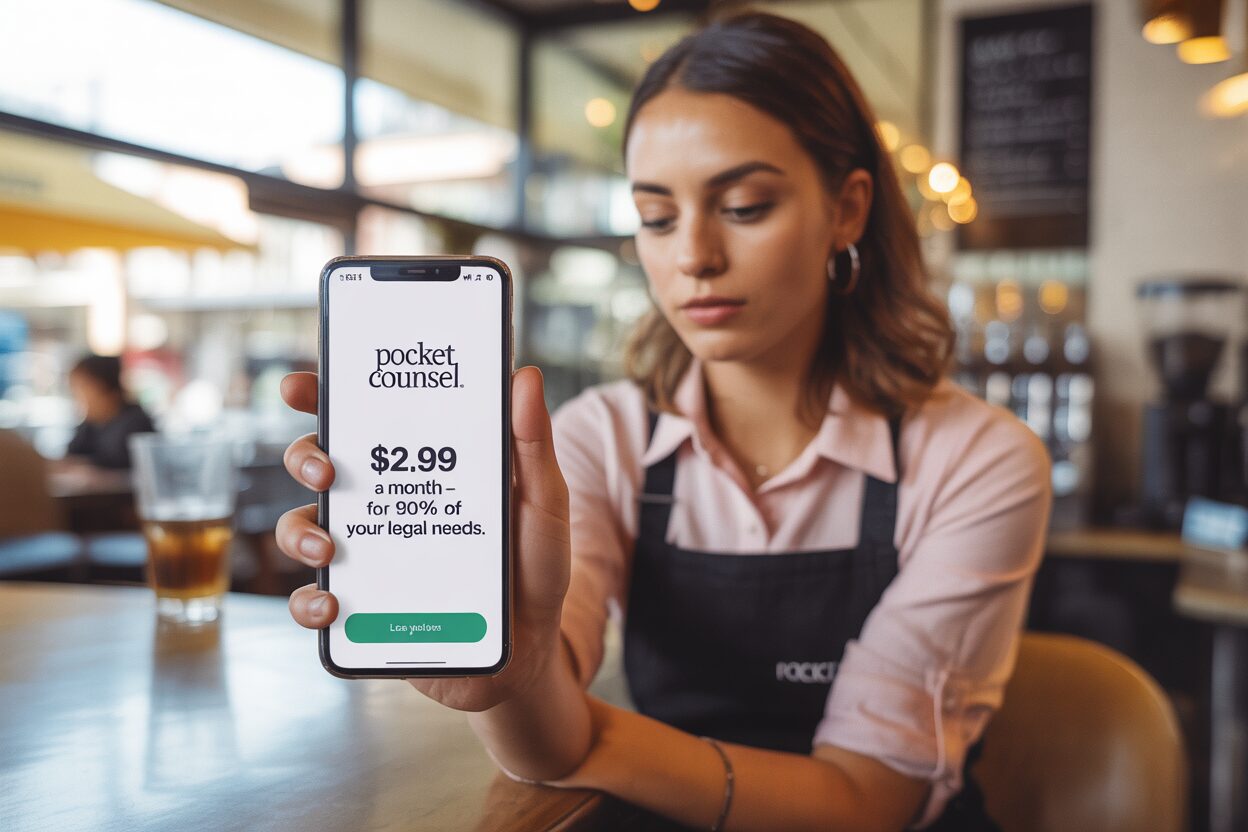
What happens to the legal industry when every person and business has the country’s top lawyer on their laptop – at negligible cost?
Imagine a day in the future…
Tuesday, 13 May 2030, 8:12 a.m.
Leila, a Melbourne barista, points her phone at a rental-bond form. Her personal AI app, which has access to every Australian state’s Civil and Administrative Tribunal orders since 2020, flags a hidden “professional cleaning” clause that routinely gets struck down.
The app proposes new wording, warns her how to negotiate, and lets her tap “File with Consumer Affairs.” Ten seconds later, her AI runs the new wording past a second AI app in an adversarial check, looking for hallucinations or stale precedent. Only if the two models agree above a confidence threshold is the draft released. This safety loop is now standard and has earned a colloquial name: Double-AI Verification. Lawyers slang it as “the DAIV check” or simply “run it past DAIV.”
Leila pays a $20 a month subscription for her AI. It will handle 90% of her legal needs for years to come:
-
Tenancy disputes, unfair dismissal claims, and traffic fines.
-
Domestic-violence orders.
-
Employment and gig economy contracts.
-
Divorce and insurance claim disputes.
-
Buying or selling real estate and updating a will.
-
Immigration or visa issues.
One-tap escalation routes edge cases (those with low confidence or high financial risk) to human lawyers in a gig-style marketplace. These services are capped by regulation at $150/hr and subsidised for Legal Aid clients. For minor disputes under $10,000, parties are funnelled into online tribunals where AI mediators propose settlements; a human registrar steps in only if one party clicks “reject.”
This, of course, isn’t a prophecy. It might not happen exactly this way. It might not happen exactly this quickly. But unless the trillion dollars being invested in AI amounts to nothing, we know that something is going to happen in the next few years.
How Businesses Might Use Legal AI in 2030
The Micro-Business
Most micro-business owners will use their personal AI for the bulk of their legal needs: setting up a business structure, drafting contracts, handling employment issues, protecting intellectual property, and managing commercial leases. When 90% of the legal work of 2020 is automated, the entire legal profession will be competing for the 10% that remains.
Small to Medium Enterprises (SMEs)
SMEs will subscribe to commercial-grade AI services to handle the vast majority of their legal work, including:
Corporate: Developing watertight contracts, organizing share classes, and handling M&A due diligence.
Employment: Creating enterprise agreements, managing redundancies, and handling unfair dismissal claims.
Regulatory & IP: Navigating privacy laws like the Australian Privacy Act and GDPR, managing patent portfolios, and developing IP strategy.
Litigation: Handling dispute resolution, tax structuring, and international operations.
Governance: Drafting advice for directors’ duties, creating risk registers, and ensuring ASIC compliance.
ASX-Listed Giants
Large corporations will likely develop internal, private AI systems that ingest every internal document, run constant DAIV-check reviews, and watermark every output so auditors can trace which expert-agent contributed each clause. Tech giants like AWS, Microsoft, and Google will provide industry-level, fenced-off secure solutions for companies that cannot run these systems entirely in-house.
What Will Be Left for Flesh-and-Blood Lawyers?
Human lawyers will remain essential for the work AI cannot do: providing insurable signatures, diplomacy, courtroom advocacy, and what could be called “governance theatre.” Their role will focus on four key areas:
Judgment Under Ambiguity: Handling novel situations with no training data, such as war-time sanctions or urgent climate-crisis mandates.
Credibility Theatre: Standing before a judge, a Senate committee, or an activist investor to absorb pressure and scrutiny that an algorithm cannot.
The Ethical Backstop: Signing off on a DAIV-checked process and accepting personal liability if something is missed.
High-Touch Counsel: Advising on existential deals where a wrong nuance could vaporise brand equity overnight.
The Future of Law in One Paragraph
By 2030, legal labour will be divided into two camps: instant, algorithmic service for 90% of problems, and deeply human, insurable judgment for the 10% that can still destroy a life, a company, or a reputation. All of it will ride on DAIV-checked intelligence, because in law, trust is the product—and even an AI needs a peer reviewer. The fundamental reinvention of the legal profession is already underway.
Related Articles
Why Humanoid Robots Actually Work Now
If you're like me, you might be wondering why humanoid robots have suddenly exploded into reality. For decades they seemed to be going nowhere and then, like AI in 2023, they suddenly seemed to become much more possible. Here's a quick breakdown on what's happened...
This Week in Humanoid News 2025-12-04
Here are a few stories that caught my attention this week. Humanoids in 2025 occupy a strange space. Public imagination is running far ahead of reality, yet the underlying capabilities are improving faster than most analysts predicted even two years ago. The...
Humanoids: The Week Everything Quietly Shifted
The humanoid robotics sector had one of those weeks where the signal finally started to separate from the noise. Not because of one big flashy announcement, but because of several smaller pieces that collectively point to a structural shift: humanoids are now moving...